Version 1.5
What the game does
41 features across the whole of Whitehall — the country as it actually is, an AI civil service that answers back, and an election that reads the result off the numbers you left behind. This page is updated every time the game gains something new.
Currently on v1.5 · September 2026
The country you inherit
The game opens on the United Kingdom as it actually is, not a fictional country with invented numbers.
Ten departments, one dashboard each
The Treasury, Health, Education, the Home Office, Defence, Energy, Housing, Work & Pensions, Justice and Transport — each with its own headline metrics, budget, active policies and dependencies on the others.
Real published statistics
Health, Education and the Treasury open on the real figures — the RTT waiting list, A&E performance, the 6,500 teachers pledge, debt and borrowing — each metric linking out to the publication it came from, so you can check the number yourself.
The five missions and the milestone board
The government's existing missions are already in flight when you arrive, tracked against their stated targets, with progress you inherit rather than choose.
A government that starts behind
You take office projected to lose the next election. Re-election has to be earned; a parliament that does nothing is not returned.
An AI civil service
Every department is staffed by officials you talk to in plain English. They brief you, cost your ideas, and tell you what you would rather not hear.
Eleven departmental chats
Each department — and the Cabinet Secretary's office at Number 10 — answers in its own voice, briefed on its own live figures, and ends with concrete options rather than a shrug.
Costed policy proposals
Ask for something and officials work it up properly: goal, annual cost, delivery timeline, and the specific metrics it would move, by how much, over how long.
The Treasury says no
Every costed proposal draws a Treasury assessment — support, partial funding, or opposition — with the money it displaces spelled out. This is the friction that makes it a game.
Cross-department implications
A proposal also lands on whichever department it genuinely affects, resolved from real dependencies, and they respond in parallel — a second opinion that costs you no extra waiting.
More than one department in the room
A significant proposal now draws a reaction from every department it genuinely touches, not just the first. They do not always agree with each other, and you are the one who has to settle it.
Take the option, or type your own
Officials end their advice with the two or three things you could actually do next, as buttons. Click one to give the instruction, or ignore them and say something else entirely.
Officials who will not break the law
You can order anything you like. Officials are bound by the Civil Service Code, so an unlawful or improper instruction is refused to your face, in writing, with the lawful route to what you were after — and nothing is worked up behind it. Everything short of that line, however unpopular or contested, they will do properly.
Discuss anything on screen
Every metric, mission, milestone, policy, lever, budget line and decision has a Discuss button that opens a conversation with the officials responsible for it, already knowing what you were looking at.
Decisions and consequences
Nothing happens to the country that you did not decide — and nothing you decide arrives quite as announced.
The box
Decisions and warnings queue in the red box on the Number 10 desk: approve, take the partial offer, or overrule the Treasury. Everything else — enactments, notes, things already settled — files itself out of your way.
Every department's view, on the decision itself
Each decision in the box says which department proposed it and shows where the rest of government stands: the Treasury's offer, and any department that supports it, has conditions or objects. Tap a department to read its officials' view before you sign, not after.
A red box you can feel
The box is a worn red leather case with a brass clasp, holding its papers. It opens when you sit down at the desk, a new paper rises into it when one arrives, and your decision lands as an ink stamp before the paper leaves the box.
Delivery drift
Announcing a policy is not delivering it. Under-fund a programme and it returns rather less than the money you withheld; promise to move a number further than any government has, and officials will tell you what you will actually get.
Political capital
Backing the Treasury is cheap. Overruling them costs you. Run your authority down and the officials notice.
Authority you can actually run out of
Capital is now a resource, not a score. Big, contentious policies move it further than small ones — and if it falls too low, officials will not push a policy through over the Treasury's objection at all. You take their offer, or you leave it.
The world does not wait
Things happen that you did not choose: a substation fails, the weather brings a run of Channel crossings, a housebuilder goes under. Officials brief you, the numbers move — and where you have already invested in resilience, the damage is visibly smaller.
Write your own policy
Not everything has to start as a question. Draft a policy directly, from any department or from Number 10, and put it through the same costing and Treasury scrutiny.
Ministerial levers and directives
Departments carry the dials a Secretary of State actually controls. Issue a directive and it becomes a live policy on the dashboard, discussable like any other.
Time, and seeing the future
The whole point of the game is long-term cause and effect, so the future is always on screen — and it bends when you act.
The National Clock
A live date and countdown to the general election runs across every screen, advancing while you play and stopping the moment you step away. Time never passes while you are gone.
You choose how long the parliament takes
Pick 15 to 60 minutes of your own time, and the clock is paced so that exactly that much play lands you on polling day. Asked once per parliament — win, and you set the length of the next one.
Every mark on the timeline explains itself
Click any pin — an election, a policy, a shock, or a discussion you opened — and it tells you what it was and when. Opening a new line of inquiry drops its own marker, so the timeline records what you turned your attention to, not just what happened to you.
The era bar
A timeline of everything you have governed through, pinned with every policy you enact and every decision you take, and growing by a parliament each time you are re-elected. Drag the playhead to review what you did or to look ahead at what it leads to, without disturbing the live clock.
Projections against a do-nothing line
Every metric is charted forward, with the projection you have created shown against the dotted line of the country you would have left alone. The gap between them is your record.
A deterministic engine
The numbers are computed, not improvised. The same decisions always produce the same country, so the dashboards can be trusted and the result is never a surprise.
How the country judges you
Failure is never scripted. It is read off the same dashboards you have been looking at all game.
State of the Nation
A live composite of the country's condition, computed from the headline metrics and everything you have enacted, broken down by issue and by region.
What voters think
Approval, the issues driving it, and the projected chance of re-election — all moving with the real state of the country rather than a hidden score.
The election ends it
The clock reaches 2029 and the country decides. Win and you have earned another parliament; lose and a successor takes office that afternoon.
Win, and you govern on
A returned government forms again and runs a full five years to the next election. Nothing is thrown away: your policies keep delivering, the box, your officials and your authority all carry over, and the timeline grows to hold both parliaments. You are only asked one thing again — how long you have this time.
Every term has to be earned
A second term starts from the same losing position the first did, and is judged on what you do in it — so a good first parliament is not a licence to coast. What does carry is the work still landing: a reform enacted in 2027 that only matures in 2032 counts toward the election it arrives before.
A result worth sharing
The run closes with the country you actually left behind — the index against where you started, the policies credited by name, and officials' closing assessment, ready to share.
Leave when you're ready
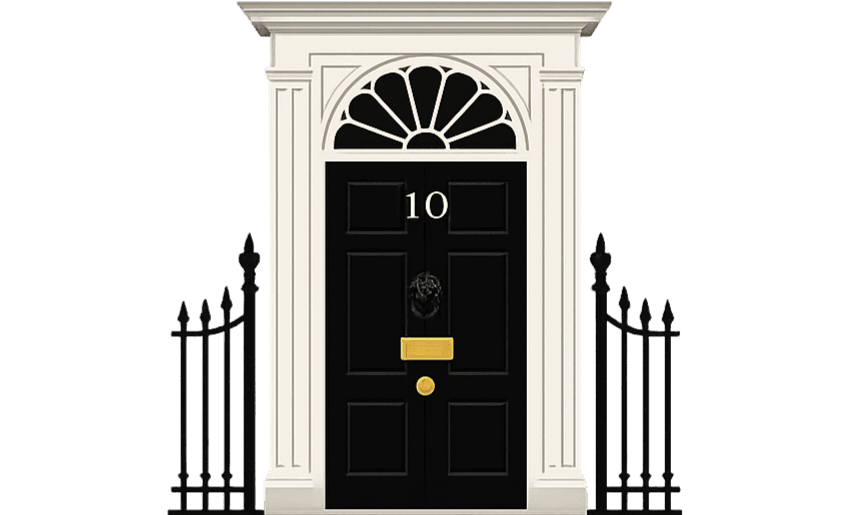
When the run ends you decide what happens to it. Carry on into the next parliament if you won, start a fresh government straight away, or clear the record entirely and walk back out of the black door — nothing is kept unless you keep it.
Problems left too long become crises
Leave an issue in the red and officials escalate: a warning at six months, a harder one at a year, and a standing indictment beyond that — each costing you authority. Two of them are already waiting for you on the day you take office.
The desk itself
The parts that are not the game, but make it playable.
Your game is always there
Every conversation, decision, policy and tick of the clock is saved as it happens. Close the tab mid-sentence and it resumes exactly where you left it.
A briefing before you take office
A first-time introduction to how the game plays, and the one choice a new government has to make, before you are dropped behind the desk.
Latest, and notifications that find you
A running feed of what your government has just done, and alerts that reach you on whichever department you happen to be standing in.
Day and night
The whole of Whitehall in light or dark, whichever suits the hour you are governing in.
Shown around the desk
The first time you arrive at Number 10, officials point out the box, the department benches and the timeline — and tell you what is already waiting for a decision.
Govern from a phone
The whole game works at any size: the chat panel opens full-screen on a handset, and the controls that will not fit fold into a single menu rather than off the edge of the screen.
The black door
There is an election in 2029.
You are behind in the polls. Officials are waiting.